Well, the obvious answer is a hat from my shop, but that's beside the point in this particular post.
I love giving gifts. I get so excited about giving them that I have to talk myself out of giving them immediately. Getting gifts is swell too. We all have things we want. New salad bowls, new jewelry, new sheets, new gadgets. It's okay to want things, and it's okay to give and receive gifts. But sometimes I think the holiday season makes people forget that there are many wonderful ways to be generous. Here are a few suggestions:
Very Sage's Non-Traditional Holiday Gift Guide (2011 Edition)
1. Let's start out with a big "duh." A unique, high-quality handmade item makes a wonderful gift. Whether you made it yourself or found something perfect at a craft fair or on Etsy, rock on.
2. Food presents. The first time I gave my friend Sara my peanut butter bon-bons she said "oh my...you have ARRIVED." Of course, make sure your food present is appropriate to the recipient's dietary restrictions. If you are giving goodies to someone you don't know very well, it's nice to wrap different things separately within the package and note important ingredients. This also gives you a chance to make cute labels with silly names like "Gluten-Free Coconut Snowflake Extravaganzas."
On a related note, do you have a great family holiday recipe that could use dusting off? Make it as a present. Every year my mom reminisces about her grandmother's Christmas cookies and laments not having time to make them. My boyfriend and I banished her from the kitchen on Christmas Eve Day and made a huge batch of cookies using the original splotchy index card recipe. It was a little hard to understand what Mom was saying through all those cookie crumbs, but we're pretty sure she loved it -- both the cookies and the idea of restarting a family tradition.
3. Old stuff. I don't get why antiques and vintage goods get all the glory, while regular old used items are uncool until they've had more time to age. Sometimes you really find the perfect gift in a flea market or thrift store. Does that beautiful coffee table book deserve any less respect because you got it at a stoop sale? Is that funky glass candy dish any less gift-worthy because you found it at the Goodwill? Of course you'll want to check your find for stains, mysterious odors, and all the usual practical stuff. Of course, that's something you often have to do with brand new items at some stores (ahem, Brooklyn Target).
4. Memories. When I graduated from college my grandfather gave me a little book of memories. It was something my parents had found in a bookstore, with a different question on each page. I learned so much about him from that little book, and it prompted some great conversations. You don't need to be elderly to share your memories, and it doesn't have to be a full on memoir. Consider writing a letter about the first time you and your loved one met, or a meaningful moment in your relationship. Too many to choose from? Write a bunch of memories on slips of paper and stuff them in a pretty box. It's like a reverse fortune cookie -- every time your loved one pulls out a piece of paper, he or she gets to relive something that you two shared.
5. The Two-Person Book Club. We're all busy people with lots of things to do. There are people we want to talk to more often, there are books we want to read, and it never feels like there's enough time for either of those things. Enter the two-person book club. It has all the benefits of a real book club (exposure to new books, intellectual stimulation, great conversation) and none of the drawbacks (pressure to read quickly, scheduling difficulties, that lady who only picks romance novels). Since it's just the two of you, you can pick the books you want to read and meet by phone or in person whenever it is convenient. It gives you an added incentive to keep in touch and lets you learn new and interesting things about your reading partner.
6. Charitable Giving. Perhaps more than any of the gifts on this list, this one needs to be tailored to the recipient's special interests and values. It's best to research where your money actually goes, how the organization acknowledges gifts (i.e. if their card could spoil the surprise), and whether the organization's mission and actions are in line with your friend's beliefs. Just to get you thinking, here are a few that I like:
Charity:Water helps to bring clean and safe drinking water to people in developing nations: http://www.charitywater.org/
Bideawee is a New York-area animal rescue and veterinary facility that rescues animals from kill shelters and finds them loving homes: http://www.bideawee.org/index.php
Heifer International provides livestock and training to families all over the world, helping entire communities to improve their nutrition and their lives: http://www.heifer.org/homeview
Have you made it this far? I applaud you. Happy giving!

Friday, December 2, 2011

Tuesday, November 29, 2011
Wherever She May Be, It Will ALWAYS Be the Emily Hat
You may not know this about me, but my go-to Very Sage model has been my best friend since we were 12. Emily is lovely, of course, and she has always been wonderfully amenable to letting me take hat pictures on a moments' notice. She is even the inspiration behind a Very Sage hat style.
After a few years of living wonderfully close to each other here in Brooklyn, Emily is now on a trip around the world! (You should really check out her blog.) As happy as I am for her, I miss her like crazy. I also found myself in a bind when the time came to photograph my new inventory.
Luckily, I have lots of gorgeous friends -- although I still plan on telling Emily that it took three ladies to fill her shoes during our recent photo shoot in Madison Square Park. Here are some highlights.
 Val rocks the Organic Cotton Sapphire Blue Emily Hat (left). I'd been wanting to make a cotton ear flap hat for a while, but cotton is kind of funny. It has a stretchy texture that doesn't lend itself very well to hats, and the actual yarn ranges from slippery to bristly. Also, the color selection is usually terrible. I guess the assumption is that people only make cotton things for babies, so unless you want to sport a cotton hat in rubber ducky yellow you're up a creek. When I found this silky organic cotton in an actual grown-up color, I pounced. I only wish they had had more colors! I would have loved to make one in green.
  This may be the greatest picture I have ever taken of anyone, ever (right). Zehra is glamorous and elegant, but she's also a total bad-ass. If this picture doesn't make you want an orange hat of your very own, you must be blind. It obviously imbues the wearer with a special brand of awesomeness. I could use some of that awesomeness for myself.
 As you may have noticed, I love bright colors. I think New Yorkers are entirely too interested in neutrals. Why not take a leaf out of Morgan's book and spice things up with a bit of bright red (left)?

After a few years of living wonderfully close to each other here in Brooklyn, Emily is now on a trip around the world! (You should really check out her blog.) As happy as I am for her, I miss her like crazy. I also found myself in a bind when the time came to photograph my new inventory.
Luckily, I have lots of gorgeous friends -- although I still plan on telling Emily that it took three ladies to fill her shoes during our recent photo shoot in Madison Square Park. Here are some highlights.
 Val rocks the Organic Cotton Sapphire Blue Emily Hat (left). I'd been wanting to make a cotton ear flap hat for a while, but cotton is kind of funny. It has a stretchy texture that doesn't lend itself very well to hats, and the actual yarn ranges from slippery to bristly. Also, the color selection is usually terrible. I guess the assumption is that people only make cotton things for babies, so unless you want to sport a cotton hat in rubber ducky yellow you're up a creek. When I found this silky organic cotton in an actual grown-up color, I pounced. I only wish they had had more colors! I would have loved to make one in green.
  This may be the greatest picture I have ever taken of anyone, ever (right). Zehra is glamorous and elegant, but she's also a total bad-ass. If this picture doesn't make you want an orange hat of your very own, you must be blind. It obviously imbues the wearer with a special brand of awesomeness. I could use some of that awesomeness for myself.
And what is a Very Sage photo shoot without a Jaunty Newsboy or two?
 As you may have noticed, I love bright colors. I think New Yorkers are entirely too interested in neutrals. Why not take a leaf out of Morgan's book and spice things up with a bit of bright red (left)?
 Then again, I also think that a really great hat doesn't have to match your outfit, and that idea shows no sign of catching on. The first Jaunty Newsboy I ever made was a mix of three different shades of green and two purples. It goes with absolutely nothing, and I wear it all the time.
Last but not least, here is my favorite from the day. Many thanks to my lovely ladies! Check out the shop for more new stuff.

Very Sage, where have you been?
Nearly a year without a post? Absurdity!
I have kind of a good excuse, though. Not long after I posted my last update I became a real, live attorney. Like, the kind with a job.
The pros: A salary (it's nothing like what you're thinking. I'm not that kind of lawyer). Learning new things. Meeting new people (also sometimes a con). Health insurance!
The cons: long commutes all over the City (sort of a pro, although my yarn sheds all over my suits and I look like I have a multicolor dog), not enough sleep, working nights and weekends waaaaay too often, and not enough time to design new things. But still -- a salary! Health insurance!
In other good news: I went in for a 6-month check up and had a chest x-ray, and the pneumonia was fully resolved. Let's hope that never, ever happens again.
On to more business-y things. Very Sage has been resurrected for the holiday season. Things have been quiet so far. I'm having a hard time standing out in the crowd (see previous post on "made in China"). I'm having an even harder time with the realities of business: to succeed, you have to make what the people want. And the people want...baby booties.
Baby booties. It started as a way for me to give a homemade, heartfelt gift to the bazillion people in my life who are reproducing. It became a monster. Sure, they're cute. But they fit for 10 minutes, and they take way too long to make. I only have one design that I really like (suitable for boys and girls, not too fussy) and I haven't perfected my technique yet for speedy production. It's often more difficult to make something small than it is to make something large because of the detail involved.
It comes down to this: hats are fun. Booties are work. Just like children, right? So...what do I do now?
I have kind of a good excuse, though. Not long after I posted my last update I became a real, live attorney. Like, the kind with a job.
The pros: A salary (it's nothing like what you're thinking. I'm not that kind of lawyer). Learning new things. Meeting new people (also sometimes a con). Health insurance!
The cons: long commutes all over the City (sort of a pro, although my yarn sheds all over my suits and I look like I have a multicolor dog), not enough sleep, working nights and weekends waaaaay too often, and not enough time to design new things. But still -- a salary! Health insurance!
In other good news: I went in for a 6-month check up and had a chest x-ray, and the pneumonia was fully resolved. Let's hope that never, ever happens again.
On to more business-y things. Very Sage has been resurrected for the holiday season. Things have been quiet so far. I'm having a hard time standing out in the crowd (see previous post on "made in China"). I'm having an even harder time with the realities of business: to succeed, you have to make what the people want. And the people want...baby booties.
Baby booties. It started as a way for me to give a homemade, heartfelt gift to the bazillion people in my life who are reproducing. It became a monster. Sure, they're cute. But they fit for 10 minutes, and they take way too long to make. I only have one design that I really like (suitable for boys and girls, not too fussy) and I haven't perfected my technique yet for speedy production. It's often more difficult to make something small than it is to make something large because of the detail involved.
It comes down to this: hats are fun. Booties are work. Just like children, right? So...what do I do now?
Saturday, January 8, 2011
My New Year's Resolutions, or, Blogging from my Deathbed
Okay, so I have a flair for the dramatic. I am not actually on my deathbed. I am, however, on my sickbed. For those of you keeping track at home, I've been griping about Death Cold 2010 since mid-December. I found out two weeks ago that Death Cold 2010 had morphed into Inconvenient Pneumonia 2010-2011. I found this out when my inability to breathe landed me in the ER on Boxing Day. I spent the afternoon with an IV in my arm, imbibing a tasty cocktail of cough syrup, albuterol, and antibiotics.*
It took an extra week at my parents' house for me to be well enough to travel, but I finally got the go ahead to travel back to Brooklyn. I still have to rest non-stop, but now that I'm no longer sleeping 22 hours a day I have some time on my hands to think about things that I would like to accomplish in the new year.
Very Sage's Totally Attainable With a Little Work New Year's Resolutions
1. Unravel the mystery that is New York State's destination-based sales tax system
Since New York prides itself on making things as difficult as possible, it shouldn't be surprising that this fair state's system for online sales tax is a riddle wrapped in an enigma wrapped in bureaucratic red tape. I'm not tax expert, but I know that I am supposed to charge people sales tax. Since my shop is an online entity based in New York, I am supposed to charge my customers tax based on their location. This means that I cannot act as though they've walked into my quaint little imaginary shop in Brooklyn; we have to pretend that I have traveled to the buyer's political district (yep, we can't use something simple like a zip code) to make the sale. Paypal lets you set up a tax rate for your own location, but as far as I can tell there is no way to automatically add tax based on the buyer's location. The only way to handle this is to process each transaction twice: the buyer purchases the item without actually paying, then I send the buyer an updated Paypal invoice that includes the tax amount, THEN the buyer actually purchases the product. Or doesn't, because maybe she's changed her mind during all this dilly-dallying. For a more cogent and less whiny explanation of this system, check out this great blog entry at Go to Great Panes.
Like everyone else in New York, I live in fear of the Tax Man. The last thing I can afford right now is to owe him money in April. Thus, I am officially going Nancy Drew on the System to figure out what I should be doing and when I have to do it. Also, wouldn't the powers that be be better off going after all those rich people who haven't paid income tax since the 80s?
2. Design fabric labels for my products to increase brand recognition
I know, it's funny to think that something I crochet on my couch qualifies as a brand. Be that as it may, tags communicate a message -- and I don't just mean nuts and bolts information like materials and place of production. A tag makes a handmade item look more professional, and thus more desirable. Maybe if your grandma had sewed a fancy tag with a brand name like Granny Millicent's Couture into your sweaters you wouldn't have given them all to the Goodwill.
There are a few obstacles to my label goal, the main one being that I am very, very cheap. I don't want to spend loads of money on something that probably won't generate much income. I also have very specific ideas about how I want my labels to look -- the last thing I want is to be stuck with the templates and fonts that the company offers.
I think that my best bet is to invest in some satin ribbon and iron-on transfer paper. It will be a hassle to make them one at a time, but I haven't found any pre-made woven labels for the right price.
3. Streamline the Inventory
I enjoy making lots of different styles of hat, but I definitely have two styles (ear flap hats with ties and jaunty newsboys) that are most popular. I like making both of them, and I hate the thought that I will get tired of them, but it makes sense for me to make these two styles in lots of colors and hold off for a while on other items. I initially started making pins, fingerless gloves, and small purses in an effort to introduce different price points into the shop. The fact of the matter is that they are not selling very well. I always thought it was a strength to have a lot of different items, but I'm starting to think that it is hurting my shop. I've done some research on other, considerably more successful shops that offer crocheted items. They tend to offer a few designs in many colors. Maybe if I made a dozen pairs of fingerless gloves in different colors I would be able to appeal to more people. I get the sense that if shoppers do not see the color that they want, they cruise off to another shop rather than going through the process of placing a custom order.
So from now on, I'm holding off on making anything other than hats. I want to spend some time perfecting a few core styles and widening my color offerings. The good thing is that I'm my own boss on this -- if I decide I hate making the same thing over and over again, I can change things up.
One good thing on being on pneumonia-induced modified bed rest is that I have plenty of time to crochet. My sweet mom was kind enough to restock my yarn stash for Christmas, and then to supplement it again as a "We're really sorry you have pneumonia" present before I left the nest, so at least I have a lot of great materials to work with.
4. Write It Down
People often ask me if I work from patterns. All of my work is based on patterns that I design myself (once you learn to crochet a basic hat crown in the round, the world of hatting is your oyster). But here's the thing -- I've never written any of my patterns down. On occasion I'll make something I really like, sell it, and then get a request for an identical item. The last thing I want to say is "Oops, I made that hat 3 months ago and have no idea how I did it." So far I've muddled through by looking at pictures of the original hat, but it would be really helpful to have it all written down -- especially the patterns for my tried and true designs so I can make sure I'm achieving uniformity.
This will be especially helpful when I develop amnesia from trying to teach myself NY sales tax law.
Happy New Year!
*A word to the wise: if you don't have health insurance, don't even think about getting pneumonia.
It took an extra week at my parents' house for me to be well enough to travel, but I finally got the go ahead to travel back to Brooklyn. I still have to rest non-stop, but now that I'm no longer sleeping 22 hours a day I have some time on my hands to think about things that I would like to accomplish in the new year.
Very Sage's Totally Attainable With a Little Work New Year's Resolutions
1. Unravel the mystery that is New York State's destination-based sales tax system
Since New York prides itself on making things as difficult as possible, it shouldn't be surprising that this fair state's system for online sales tax is a riddle wrapped in an enigma wrapped in bureaucratic red tape. I'm not tax expert, but I know that I am supposed to charge people sales tax. Since my shop is an online entity based in New York, I am supposed to charge my customers tax based on their location. This means that I cannot act as though they've walked into my quaint little imaginary shop in Brooklyn; we have to pretend that I have traveled to the buyer's political district (yep, we can't use something simple like a zip code) to make the sale. Paypal lets you set up a tax rate for your own location, but as far as I can tell there is no way to automatically add tax based on the buyer's location. The only way to handle this is to process each transaction twice: the buyer purchases the item without actually paying, then I send the buyer an updated Paypal invoice that includes the tax amount, THEN the buyer actually purchases the product. Or doesn't, because maybe she's changed her mind during all this dilly-dallying. For a more cogent and less whiny explanation of this system, check out this great blog entry at Go to Great Panes.
Like everyone else in New York, I live in fear of the Tax Man. The last thing I can afford right now is to owe him money in April. Thus, I am officially going Nancy Drew on the System to figure out what I should be doing and when I have to do it. Also, wouldn't the powers that be be better off going after all those rich people who haven't paid income tax since the 80s?
2. Design fabric labels for my products to increase brand recognition
I know, it's funny to think that something I crochet on my couch qualifies as a brand. Be that as it may, tags communicate a message -- and I don't just mean nuts and bolts information like materials and place of production. A tag makes a handmade item look more professional, and thus more desirable. Maybe if your grandma had sewed a fancy tag with a brand name like Granny Millicent's Couture into your sweaters you wouldn't have given them all to the Goodwill.
There are a few obstacles to my label goal, the main one being that I am very, very cheap. I don't want to spend loads of money on something that probably won't generate much income. I also have very specific ideas about how I want my labels to look -- the last thing I want is to be stuck with the templates and fonts that the company offers.
I think that my best bet is to invest in some satin ribbon and iron-on transfer paper. It will be a hassle to make them one at a time, but I haven't found any pre-made woven labels for the right price.
3. Streamline the Inventory
I enjoy making lots of different styles of hat, but I definitely have two styles (ear flap hats with ties and jaunty newsboys) that are most popular. I like making both of them, and I hate the thought that I will get tired of them, but it makes sense for me to make these two styles in lots of colors and hold off for a while on other items. I initially started making pins, fingerless gloves, and small purses in an effort to introduce different price points into the shop. The fact of the matter is that they are not selling very well. I always thought it was a strength to have a lot of different items, but I'm starting to think that it is hurting my shop. I've done some research on other, considerably more successful shops that offer crocheted items. They tend to offer a few designs in many colors. Maybe if I made a dozen pairs of fingerless gloves in different colors I would be able to appeal to more people. I get the sense that if shoppers do not see the color that they want, they cruise off to another shop rather than going through the process of placing a custom order.
So from now on, I'm holding off on making anything other than hats. I want to spend some time perfecting a few core styles and widening my color offerings. The good thing is that I'm my own boss on this -- if I decide I hate making the same thing over and over again, I can change things up.
One good thing on being on pneumonia-induced modified bed rest is that I have plenty of time to crochet. My sweet mom was kind enough to restock my yarn stash for Christmas, and then to supplement it again as a "We're really sorry you have pneumonia" present before I left the nest, so at least I have a lot of great materials to work with.
4. Write It Down
People often ask me if I work from patterns. All of my work is based on patterns that I design myself (once you learn to crochet a basic hat crown in the round, the world of hatting is your oyster). But here's the thing -- I've never written any of my patterns down. On occasion I'll make something I really like, sell it, and then get a request for an identical item. The last thing I want to say is "Oops, I made that hat 3 months ago and have no idea how I did it." So far I've muddled through by looking at pictures of the original hat, but it would be really helpful to have it all written down -- especially the patterns for my tried and true designs so I can make sure I'm achieving uniformity.
This will be especially helpful when I develop amnesia from trying to teach myself NY sales tax law.
Happy New Year!
*A word to the wise: if you don't have health insurance, don't even think about getting pneumonia.
Saturday, December 18, 2010
Slow Going, and Some Recommendations
My crafting tends to wax and wane, and right now it's definitely waning. As I plod toward Christmas and work gets busier I find that I barely have the energy to sketch out new designs, let alone make anything. Part of the problem is that I'm recovering from what I have billed Death Cold 2010; I haven't really thought clearly since last Sunday and spent nearly 72 straight hours in bed earlier this week (as you may have guessed, I am not normally a particularly restful person). The rest of the problem is that my yarn supply is criminally skimpy right now. When I crocheted as a hobby buying materials wasn''t that big of a deal. Now that I'm having a going at entrepreneurship, budgeting and cost-benefit analyses make trips to the yarn store a little less fun. Now I feel like I can only buy yarn once I've sold something. While my sales for this month have been good I never got the major holiday pop that I've been hoping for since July.
I hope that the cute local yarn store near my parents' house, the Woolly Lamb, might have some good sales after Christmas. If any of you are in Western New York, the Woolly Lamb is well worth a visit. It's one of those quaint yarn shops that has been in business for many years, and perusing their shelves is like wandering through a really beautiful candy shop. It's a cozy space with couches and chairs, and there are always people working or talking about their projects (one of the hallmarks of a great neighborhood yarn shop). The prices are reasonable for the range and quality of yarns offered. The variety is amazing, the colors delicious, and the textures diverse and intriguing. It's also crochet-friendly. I mention this because, as a crocheter, I am very put off by yarn shops that only cater to knitters -- i.e. only selling knitting patterns, not stocking hooks, etc.. It's those shops' loss -- especially since crochet projects use about 1/3 more yarn. One of the best things about the Woolly Lamb is the staff. The women I've met who work their are knowledgeable, kind, patient, and eager to share many years of wisdom.
I actually have a special place in my heart for this shop because of something that happened in my house a few Christmases ago. I had carelessly left my stocking on the floor (this would have all been avoided had I simply hung it by the chimney with care) when our belovedly devious Cairn terrier caught wind of a Truffalo bar inside. Rocky took the shortest route to the chocolate bar and chewed a large hole in the wonderful knitted stocking that I have had since I was a very little girl. Tears ensued. When I headed back to Brooklyn my mother took the stocking to the Woolly Lamb for a consult, assuming that it was a lost cause. Not only was the woman there able to fix it, she was even able to match the circa-1982 yarn!
Stay tuned for another review of a shop in my very own Brooklyn, my beloved Brooklyn General Store. Want to know why I tend to leave BGS with a tummy as full as my wallet is empty? Check back soon to find out.
I hope that the cute local yarn store near my parents' house, the Woolly Lamb, might have some good sales after Christmas. If any of you are in Western New York, the Woolly Lamb is well worth a visit. It's one of those quaint yarn shops that has been in business for many years, and perusing their shelves is like wandering through a really beautiful candy shop. It's a cozy space with couches and chairs, and there are always people working or talking about their projects (one of the hallmarks of a great neighborhood yarn shop). The prices are reasonable for the range and quality of yarns offered. The variety is amazing, the colors delicious, and the textures diverse and intriguing. It's also crochet-friendly. I mention this because, as a crocheter, I am very put off by yarn shops that only cater to knitters -- i.e. only selling knitting patterns, not stocking hooks, etc.. It's those shops' loss -- especially since crochet projects use about 1/3 more yarn. One of the best things about the Woolly Lamb is the staff. The women I've met who work their are knowledgeable, kind, patient, and eager to share many years of wisdom.
I actually have a special place in my heart for this shop because of something that happened in my house a few Christmases ago. I had carelessly left my stocking on the floor (this would have all been avoided had I simply hung it by the chimney with care) when our belovedly devious Cairn terrier caught wind of a Truffalo bar inside. Rocky took the shortest route to the chocolate bar and chewed a large hole in the wonderful knitted stocking that I have had since I was a very little girl. Tears ensued. When I headed back to Brooklyn my mother took the stocking to the Woolly Lamb for a consult, assuming that it was a lost cause. Not only was the woman there able to fix it, she was even able to match the circa-1982 yarn!
Stay tuned for another review of a shop in my very own Brooklyn, my beloved Brooklyn General Store. Want to know why I tend to leave BGS with a tummy as full as my wallet is empty? Check back soon to find out.
Sunday, December 12, 2010
Too Much, Not Enough: Competing with "Made in China"
"Why does this cost so much?"
People ask me that question all the time, both about my own work and at my retail job. When I sell my work at craft shows, many people express dismay at my prices. After all, why should they buy a handmade Jaunty Newsboy hat from me for $31 when they can buy what they think of as a comparable item from Target for $14.99?
Before I explain my pricing, I would like to revisit an important and oft-forgotten event in American history.
On Saturday, March 25, 1911, five hundred women reported to work at the Triangle Shirtwaist Factory on the eighth, ninth, and tenth floors of the Asch Building in New York's Washington Square. Most of the garment workers were young immigrant girls who worked 9 hours a day to help support their families. The girls worked for very low weekly wages in unsanitary conditions and were often locked in the factory during working hours. When a fire broke out on the eighth floor the flames quickly spread throughout the factory, with the textiles acting as an accelerant. Terrified workers swarmed the one unlocked staircase and crowded the building's single fire escape, which twisted and collapsed under their weight; dozens of girls fell eight stories to the ground. Some workers were able to escape to the roof or by freight elevator to the ground floor, many with their clothing still on fire. When these exits became inoperable, the girls began to jump from the windows. Passersby initially thought that the owners were throwing bolts of cloth from the windows. Only when they drew closer to the building did they realize that they were watching young women jump to their deaths to avoid being burned alive. Firemen later discovered bodies melted together against the locked door. One hundred and forty-six people died in the fire, and seventy-one escaped with injuries.
The Triangle Fire was one of the most gruesome workplace disasters in American history. In addition to inspiring industrial regulations, wage and hour restrictions, and fire safety standards, the Triangle Fire also gave rise to a class action law suit brought by survivors and family members of the deceased young women. (For a riveting account of the Triangle Fire and the labor reforms that followed, see David Von Drehle's Triangle: The Fire That Changed America.)
Let's look at modern day American labor and employment law. The federal minimum wage is $7.25. Non-exempt American workers receive overtime when they work more than 40 hours per week. The United States also has laws to control family and medical leave, prevent child labor, and provide for unemployment insurance. (For more information on all of these topics, visit the Department of Labor website.) While the laws are not perfect (you'd be amazed how many employers are exempt from compliance with basic employee protections, and there are still numerous sweatshops in operation in the US) labor laws make a huge difference in our collective working life.
Now, let's examine the labor practices in the country the provides most of our cheap imported goods: China. Activists for the global garment industry have documented the working conditions of Chinese garment workers since the early 1990s. At present, the average hourly wage in Southern China is about $0.75 American cents thanks in part to an unlimited supply of cheap labor. Despite American companies' highly publicized promises to avoid buying sweatshop goods, lax enforcement encourages the maintenance of the status quo. Furthermore, many factories have simply become more adept at concealing their practices. Chinese factory workers are frequently locked in the facility, forced to live in prison-like dormitories, and denied access to food or restrooms during the 14-hour work day. (Again, these practices are by no means exclusive to China. If you do a little digging you will encounter sweatshops right here in New York City, where manufacturers benefit from an unlimited supply of illegal immigrant laborers that are often both unaware of their rights and fearful of deportation.)
Why is this allowed? Because we Americans are accustomed to cheap stuff. We are used to buying our food, especially our protein, at inflation-proof prices supported by government subsidies to factory farming operations (everyone who eats should read Eating Animals by Jonathan Safran Foer). And thanks to foreign sweatshops that handily avoid American labor restrictions, we can buy that hat for $14.99. Who cares how it was made, as long as it's cheap?
As you may have guessed, it is all but impossible for an artisan to compete with prices like that. I strive to appeal to my customers on the grounds of quality, uniqueness, and conscience, but I almost always have to sell myself short to make a sale. Let me give you a breakdown of my own costs for making a hat like my Charcoal Gray Eco-Wool Ear Flap Hat:
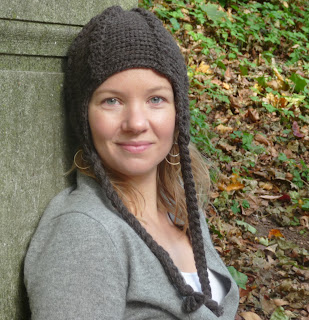 Cute, right? The first thing you should know is that I do not work from other people's patterns. I design ALL of my products myself. But for the sake of this analysis, we will ignore the time spend in the design process and stick to production costs.
1. Materials: I work almost exclusively with natural fibers. I do this for a few reasons: acrylic, while considerably cheaper, irritates my hands if I work with it too much. Plus, wool is a renewable resource and acrylic yarn is made from petroleum. Yuck.
This hat is made of eco-wool, which is a very high quality wool yarn at an economic $15 per skein. The skeins (units in which yarn is sold) are quite large, so I was able to make this hat from a single skein.
2. Labor: It takes me about 4-5 hours to make a hat like this. Twisted cables look great, but they slow down the production process considerably. Still, this style of hat is very popular this year so I like to include some of them in my shop at all times. Let's say I'm working very quickly and I finish this hat in 4 hours. If I were to pay myself minimum wage ($7.25) that would amount to $29.
3. The Math: You've probably figured this out already. To recoup my investment and pay myself a fair wage, I would have to charge $44 for my hat. In order to stay competitive -- even in the Etsy marketplace, which is supposed to be devoted to handmade goods -- I'm charging $31, for the simple fact that no one will pay me what the hat is worth. Even if someone buys this hat (and there are no guarantees that will happen), I will still lose money.
If you've made it this far into my manifesto, I applaud you. I'm not trying to throw a pity party for myself, because I really enjoy the crafting process. But I also think it's essential that we think more critically about the work that goes into our purchases.
It comes down to this: shoppers are asking the wrong questions. Rather than looking at the handmade item and asking "why does this cost so much?" they should be looking at the mass-produced item and asking "why does this cost so little?"
They might not like the answer.
People ask me that question all the time, both about my own work and at my retail job. When I sell my work at craft shows, many people express dismay at my prices. After all, why should they buy a handmade Jaunty Newsboy hat from me for $31 when they can buy what they think of as a comparable item from Target for $14.99?
Before I explain my pricing, I would like to revisit an important and oft-forgotten event in American history.
On Saturday, March 25, 1911, five hundred women reported to work at the Triangle Shirtwaist Factory on the eighth, ninth, and tenth floors of the Asch Building in New York's Washington Square. Most of the garment workers were young immigrant girls who worked 9 hours a day to help support their families. The girls worked for very low weekly wages in unsanitary conditions and were often locked in the factory during working hours. When a fire broke out on the eighth floor the flames quickly spread throughout the factory, with the textiles acting as an accelerant. Terrified workers swarmed the one unlocked staircase and crowded the building's single fire escape, which twisted and collapsed under their weight; dozens of girls fell eight stories to the ground. Some workers were able to escape to the roof or by freight elevator to the ground floor, many with their clothing still on fire. When these exits became inoperable, the girls began to jump from the windows. Passersby initially thought that the owners were throwing bolts of cloth from the windows. Only when they drew closer to the building did they realize that they were watching young women jump to their deaths to avoid being burned alive. Firemen later discovered bodies melted together against the locked door. One hundred and forty-six people died in the fire, and seventy-one escaped with injuries.
The Triangle Fire was one of the most gruesome workplace disasters in American history. In addition to inspiring industrial regulations, wage and hour restrictions, and fire safety standards, the Triangle Fire also gave rise to a class action law suit brought by survivors and family members of the deceased young women. (For a riveting account of the Triangle Fire and the labor reforms that followed, see David Von Drehle's Triangle: The Fire That Changed America.)
Let's look at modern day American labor and employment law. The federal minimum wage is $7.25. Non-exempt American workers receive overtime when they work more than 40 hours per week. The United States also has laws to control family and medical leave, prevent child labor, and provide for unemployment insurance. (For more information on all of these topics, visit the Department of Labor website.) While the laws are not perfect (you'd be amazed how many employers are exempt from compliance with basic employee protections, and there are still numerous sweatshops in operation in the US) labor laws make a huge difference in our collective working life.
Now, let's examine the labor practices in the country the provides most of our cheap imported goods: China. Activists for the global garment industry have documented the working conditions of Chinese garment workers since the early 1990s. At present, the average hourly wage in Southern China is about $0.75 American cents thanks in part to an unlimited supply of cheap labor. Despite American companies' highly publicized promises to avoid buying sweatshop goods, lax enforcement encourages the maintenance of the status quo. Furthermore, many factories have simply become more adept at concealing their practices. Chinese factory workers are frequently locked in the facility, forced to live in prison-like dormitories, and denied access to food or restrooms during the 14-hour work day. (Again, these practices are by no means exclusive to China. If you do a little digging you will encounter sweatshops right here in New York City, where manufacturers benefit from an unlimited supply of illegal immigrant laborers that are often both unaware of their rights and fearful of deportation.)
Why is this allowed? Because we Americans are accustomed to cheap stuff. We are used to buying our food, especially our protein, at inflation-proof prices supported by government subsidies to factory farming operations (everyone who eats should read Eating Animals by Jonathan Safran Foer). And thanks to foreign sweatshops that handily avoid American labor restrictions, we can buy that hat for $14.99. Who cares how it was made, as long as it's cheap?
As you may have guessed, it is all but impossible for an artisan to compete with prices like that. I strive to appeal to my customers on the grounds of quality, uniqueness, and conscience, but I almost always have to sell myself short to make a sale. Let me give you a breakdown of my own costs for making a hat like my Charcoal Gray Eco-Wool Ear Flap Hat:

1. Materials: I work almost exclusively with natural fibers. I do this for a few reasons: acrylic, while considerably cheaper, irritates my hands if I work with it too much. Plus, wool is a renewable resource and acrylic yarn is made from petroleum. Yuck.
This hat is made of eco-wool, which is a very high quality wool yarn at an economic $15 per skein. The skeins (units in which yarn is sold) are quite large, so I was able to make this hat from a single skein.
2. Labor: It takes me about 4-5 hours to make a hat like this. Twisted cables look great, but they slow down the production process considerably. Still, this style of hat is very popular this year so I like to include some of them in my shop at all times. Let's say I'm working very quickly and I finish this hat in 4 hours. If I were to pay myself minimum wage ($7.25) that would amount to $29.
3. The Math: You've probably figured this out already. To recoup my investment and pay myself a fair wage, I would have to charge $44 for my hat. In order to stay competitive -- even in the Etsy marketplace, which is supposed to be devoted to handmade goods -- I'm charging $31, for the simple fact that no one will pay me what the hat is worth. Even if someone buys this hat (and there are no guarantees that will happen), I will still lose money.
If you've made it this far into my manifesto, I applaud you. I'm not trying to throw a pity party for myself, because I really enjoy the crafting process. But I also think it's essential that we think more critically about the work that goes into our purchases.
It comes down to this: shoppers are asking the wrong questions. Rather than looking at the handmade item and asking "why does this cost so much?" they should be looking at the mass-produced item and asking "why does this cost so little?"
They might not like the answer.
Friday, December 10, 2010
A Cold Cold COLD Day in the Park
Have I mentioned Emily, my go-to Very Sage model/dear dear dear friend? In addition to being stunning, she is sassy, fun, whip-smart, and an amazingly good sport about taking an early lunch to take pictures in Madison Square Park on a supremely chilly day. Now that I think about it, she's always been an amazingly good sport and an even better friend -- even when we met on the first day of seventh grade and I was all big teeth, huge glasses, and bad hair.
Here are a just a few pictures from our very chilly shoot this morning.
First, here is Emily in the new Ruby Red Jaunty Newsboy. (P.S., none of these items are on Etsy yet, but they will be very soon.) How great does the red look with the white scarf, black coat, and the gray text of the Some Dead White Guy Memorial?

And here's another one of Emily in a brand spankin' new matching hat and gloves set made from my new favorite yarn: a decadently soft blend of merino wool and silk.I'm usually not into matchy-matchy stuff, but I like these.
 Finally, check out this chunky heavyweight ear flap hat. I pounced on some amazing superfine alpaca yarn while I was home for Thanksgiving. It was everything I was looking for: super warm, squishily soft, and a beautiful light oatmeal color. Judging from the texture, I don't think that alpaca ever had an itchy thought in its life. Seriously, it's like butter.

I think I'm going to start calling my braided ear flap hats "Emily hats."
Here are a just a few pictures from our very chilly shoot this morning.
First, here is Emily in the new Ruby Red Jaunty Newsboy. (P.S., none of these items are on Etsy yet, but they will be very soon.) How great does the red look with the white scarf, black coat, and the gray text of the Some Dead White Guy Memorial?

And here's another one of Emily in a brand spankin' new matching hat and gloves set made from my new favorite yarn: a decadently soft blend of merino wool and silk.I'm usually not into matchy-matchy stuff, but I like these.

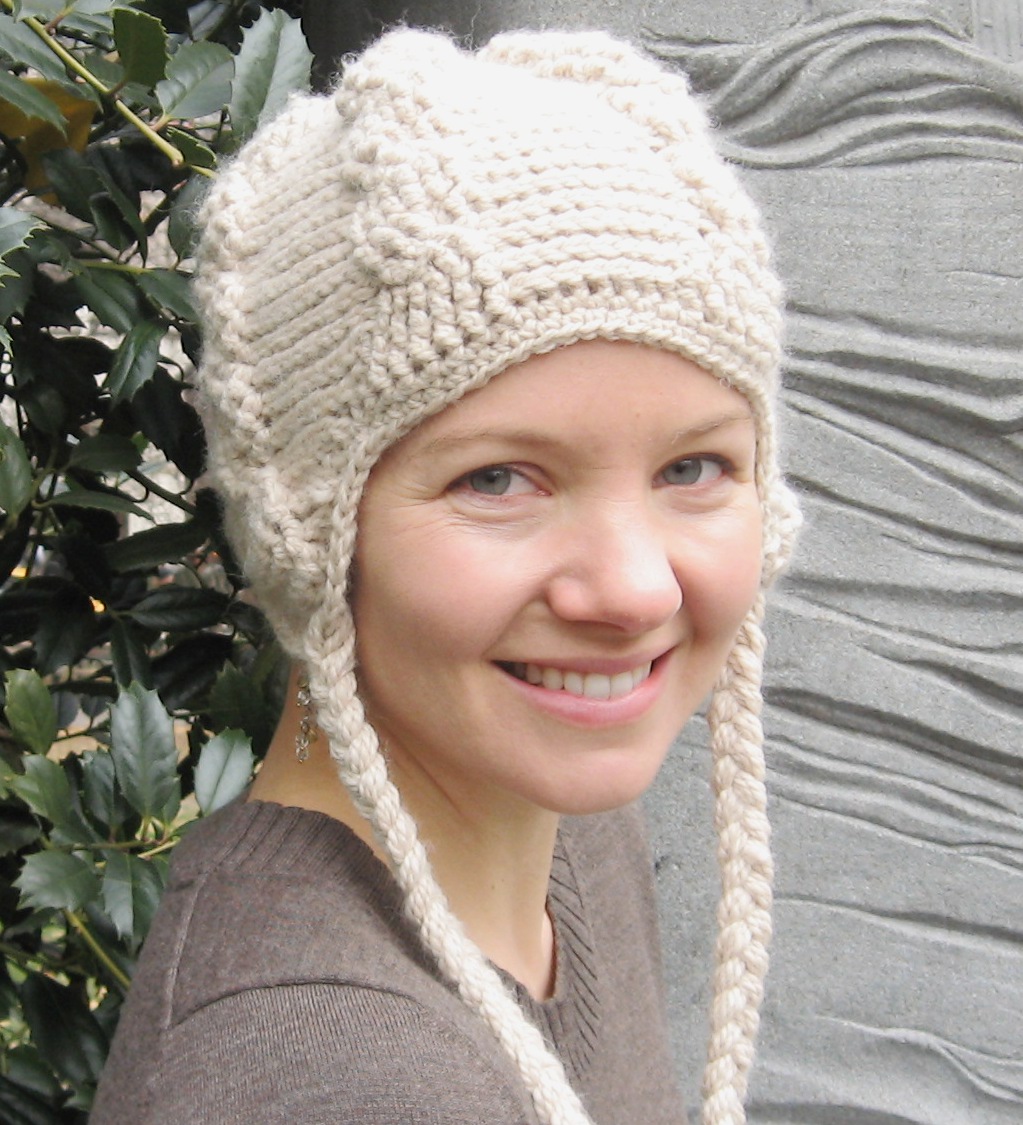
I think I'm going to start calling my braided ear flap hats "Emily hats."
Subscribe to:
Posts (Atom)